
Clare was born into the nobility of Assisi on July 16, 1194. As a little girl she was known by members of her household to be a sensitive child, gentle, prayerful and kind. She would sometimes hide food from her plate so as to later give it to the poor.
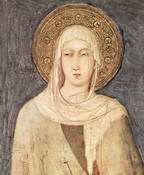 After hearing a young man (St. Francis) preach, she became determined to live the gospel in a more radical way. On the evening of Palm Sunday, March 20, 1212 she secretly left her paternal home with her cousin Pacifica, never to return. In the dead of night lit only by torches, Clare met Francis and his friars at the ‘Portiuncola’. There, in the little chapel of ‘Mary of the Angels’, she laid aside her rich clothes and Francis, after cutting off her long blonde hair, clothed her in a rough tunic and a thick veil. From that moment she vowed to live her life entirely in the service of Jesus, her heavenly spouse.
She was placed by Francis temporarily with the Benedictine nuns of San Palos near Bastia, then to San Angelo in Panzo until finally to San Damiano, which Francis had rebuilt with his own hands.Thus was founded the first community of the Order of Poor Ladies or Poor Clares.
In the beginning, most of the young girls who joined her in this life of radical poverty were from the noble families of Assisi and the surrounding area. At first they had no written rule to follow except for a very short ‘formula vitae.’ Over the years prelates tried to draw up a rule for the Poor Ladies based largely on the Rule of St. Benedict, however, Clare would reject these attempts in favour of the ‘privilege of poverty’, wishing to own nothing in this world and depending entirely on the providence of God and the generosity of the people for their livelihood.
When Pope Gregory IX visited Clare at San Damiano and tried to persuade her to accept a less strict vow of poverty she told him: “ Holy Father, I crave absolution from my sins but I desire not to be absolved from the obligation of following Jesus Christ”.
Comparatively little is known of St. Clare’s life in the cloister. We know that she became a living example of the poverty, humility and the mortification expounded by St. Francis. She had a special devotion to the Blessed Sacrament and to increase her love for Christ crucified, she learned by heart the Office of the Passion composed by St. Francis. Under her guidance the community of San Damiano became a very nursery of saints.
Clare had the joy not only of seeing her younger sister, Agnes ( St. Agnes of Assisi) join the Order but also her youngest sister Beatrix (Blessed), her mother Ortolana (Blessed) and her faithful Aunt Bianca. She lived to see the foundation of monasteries spread wide throughout Europe.
Not the least important part of Clare’s work was the help and encouragement she gave to her spiritual father, Francis. It was to her that he turned when in doubt and it was she who urged him to continue his mission in preaching when he thought his vocation lay in becoming a hermit. After receiving the Stigmata, blind, ill and dying, Francis came for the last time to San Damiano. Clare built a little reed hut for him outside the cloister and tended him. It was there that he composed his magnificent “Canticle of the Creatures”, in the spring of 1225. After his death at the Portiuncola the procession with his body stopped at San Damiano in order that Clare and her daughters might pay their respects to their father, mentor, brother and friend.